Bali is no longer just a vacation spot. It has rapidly evolved into one of Southeast Asia’s most sought-after property markets, attracting global investors in search of long-term stability, primary residences, and competitive rental yields.
This shift accelerated significantly in the post-pandemic era. Yet, beneath this compelling surface, Bali’s property market harbors legal and regulatory complexities that cannot be ignored.
As an on-the-ground practitioner, I observe two realities coexisting: a genuine, data-backed investment opportunity and significant risks that are routinely underestimated by investors proceeding without the guidance of a certified Bali real estate agent.
The Post-Pandemic Market: Year-Round Demand, Rising Stakes
The pandemic redrew the map of global property demand. When mobility collapsed, many foreign nationals reconsidered where they wanted to live, not just visit.
Bali’s climate, its fast-growing digital infrastructure, and its established expat community positioned the island as a credible permanent base, not merely a retreat. The result was a structural shift in demand: from seasonal to year-round.
This has had a direct impact on valuations. Villa occupancy rates have climbed, land prices in key corridors continue to appreciate, and interest in the best villas in Ubud or luxury clifftop homes has grown steadily. The island’s status as an investment haven is a market reality supported by data.
Where Capital Will Flow Next: Key Areas to Watch
Data points to significant appreciation over the next three to five years in areas that balance exclusivity with improving infrastructure. The emerging zones below represent where the next wave of serious capital is likely to settle:
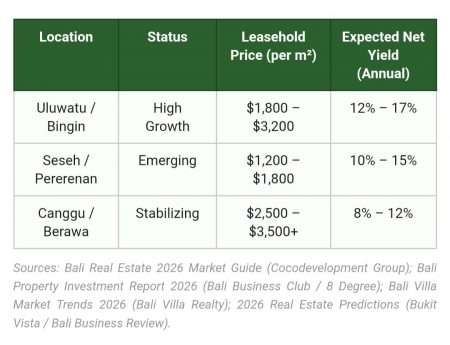
Uluwatu and Bingin lead in growth potential, fueled by clifftop scenery, world-class surf infrastructure, and surging luxury demand. Seseh and Pererenan represent the most compelling emerging markets, offering accessible entry points with significant upside.
Meanwhile, Canggu and Berawa have matured into stable, high-demand rental corridors. Given the distinct risk profile of each zone, professional due diligence is non-negotiable.
AREBI Certification: The Backbone of a Trustworthy Ecosystem
One of the most consistently misunderstood aspects of Indonesia’s property industry is the role of AREBI certification (Asosiasi Real Estate Broker Indonesia).
Many treat it as an administrative requirement. I view it differently: it is the structural backbone of the entire property ecosystem, not a credential, but a commitment to standards.
At Pure Land Bali, being certified means every property listed on our platform has already passed two layers of verification. First, zoning cross-checks against local government records to confirm the land is legally eligible for its intended use, residential, commercial, or tourism.
Second, full permit audits: every IMB or PBG document is reviewed and any discrepancy resolved before a single dollar of investor capital is committed. These are not optional steps. They are the filter that separates legitimate transactions from high-risk ones.
The Shadow Market Problem: Why Unlicensed Brokers Undermine the Entire Industry
A growing shadow market of unlicensed brokers now operates almost entirely through social media, leveraging attractive listings, impressive yield projections, and frictionless-looking processes. What is often absent is any meaningful legal accountability.
When a deal collapses due to a zoning violation, an invalid permit, or a disputed title, the damage extends beyond the individual investor; it erodes confidence in Bali as a reliable investment destination, tarnishing the island’s reputation as a whole.
Investors should treat certain patterns as non-negotiable red flags: deals that appear unusually lucrative but lack transparent documentation; agents who push for speed while bypassing due diligence; and any arrangement that frames regulatory shortcuts as an advantage rather than a liability.
In Bali’s property market, every shortcut is a deferred legal risk, and deferred risk has a way of materializing at the worst possible moment.
Compliance and ROI Are Not in Conflict
There is a persistent misconception that higher returns require some degree of regulatory compromise. This is false, a narrative that primarily benefits unlicensed operators. In reality, maximum ROI is fully achievable within the bounds of Indonesian law; legal compliance is not a hurdle, but the only reliable path to sustainable profit.
Properties with complete documentation command higher resale values, attract a broader pool of international buyers, and remain immune to the disputes that can freeze assets for years. Conversely, apparent bargains with unresolved legal issues often become significantly more expensive over time.
At Pure Land Bali, we list only properties that have cleared our rigorous legal threshold. We believe that profit potential and legal integrity are not competing priorities; they are the same.
Policy Tailwinds: Second Home Visa and What It Signals
Indonesia’s evolving visa framework, including the Second Home Visa, adds a meaningful layer of structural support to Bali’s luxury and commercial property market.
As more foreign nationals gain a legitimate long-term legal framework for residing in Indonesia, demand for premium residential and commercial assets is expected to rise.
This is not speculative. It is a logical consequence of policy that reduces friction for international capital.
One Principle for Investors Entering Bali Today
If I were to offer a single piece of guidance to a high-net-worth individual considering the Bali market today, it would be this: prioritise legal security over speculative yield.
A property built on sound legal foundations, correct zoning, complete permits, facilitated by a certified and accountable agency, is a legacy investment that will hold its value for decades.
Chasing yield at the expense of compliance, regardless of how compelling the projections look on paper, is a risk that simply does not warrant the exposure.
Bali’s opportunity is real. Realising it securely requires the right professional partner, one who treats legal integrity not as a constraint, but as the foundation of lasting returns.
Opinion by: Strategic Expert Team, Pure Land Bali
About the Authors: Pure Land Bali is an AREBI-certified property agency operating in Bali, providing investment consultancy services grounded in legal transparency, rigorous due diligence, and optimal return potential.